
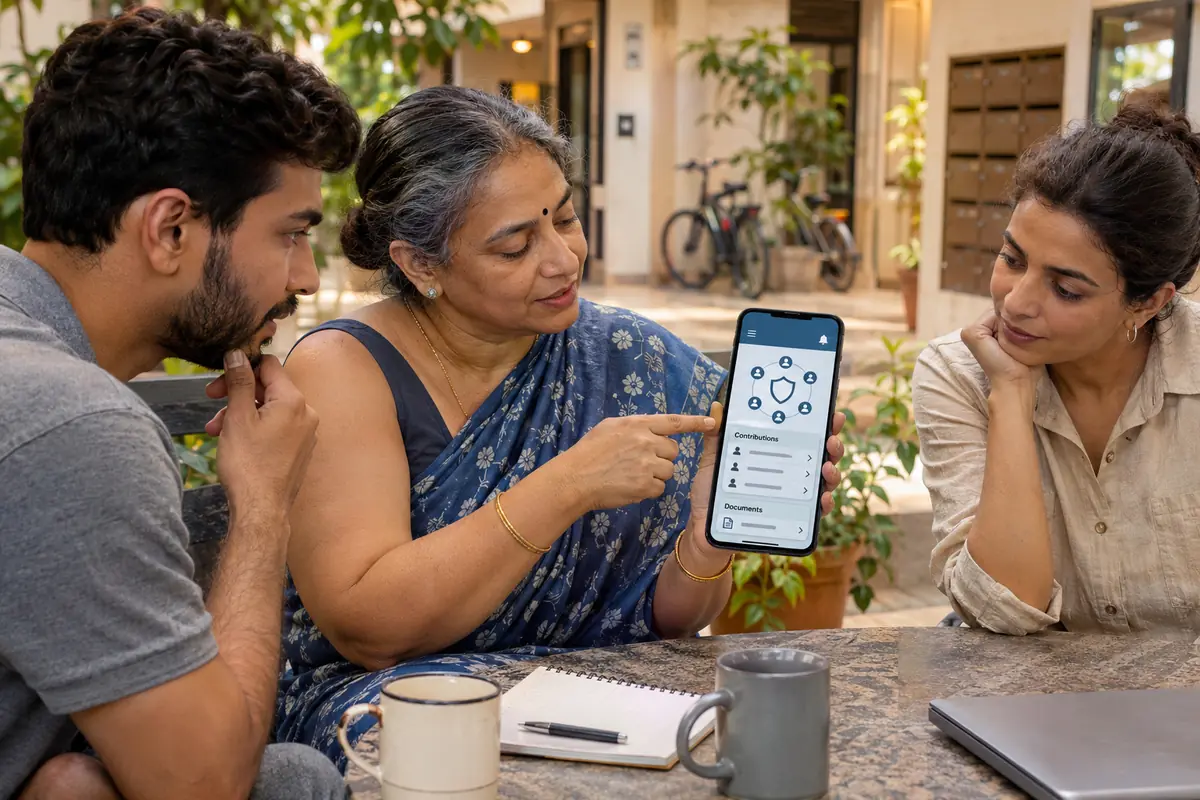
India P2P insurance is a form of mutual risk pooling in which people who face similar dangers pay small contributions into a common fund and draw on it when one member suffers a defined loss. Groups may be neighbours, traders, colleagues or members of a welfare circle. There is no insurer carrying the risk, so payouts depend on money actually collected, and any surplus may return to members. Because insurance business in India is regulated and licensed, informal pools sit in a sensitive legal area, and members should understand the rules before contributing.
How a mutual pool works
A pool starts with a group that shares a similar exposure: tenants of one housing society, drivers working the same route, small shopkeepers in a market, or members of a community welfare circle. Each member pays a modest contribution into a common account. When a member suffers a covered loss, the pool pays out according to rules agreed in advance.
The central idea is that losses are rare for any one person but predictable for a group. Spreading them removes the need for a commercial insurer to add profit margins, large sales commissions and heavy overheads to every premium.
India P2P insurance mutual risk pooling: what to check first
A licensed insurer sells a contract, carries the risk on its own balance sheet and must hold prescribed reserves. A pool does not do any of this. Members carry each other's risk directly, so a bad year can exhaust the fund and leave claims partly paid.
- No guaranteed sum: payouts depend on the money actually collected.
- Rules written by the members, not filed with a regulator.
- Surplus can return to members or roll into the next period.
- Little or no recourse to an ombudsman if a dispute arises.
Types of risk that groups pool
Small, frequent and easily verified losses suit pooling best. Large or hard-to-measure risks do not.
Suitable risks
- Mobile phone and laptop damage within a college or office group.
- Short hospital stays, minor accidents and medicine costs inside a village or neighbourhood association.
- Damage to a shop's stock from a fire or water leak in a market association.
- Funeral and bereavement costs inside a community welfare circle.
Poor fits
Motor third-party liability is compulsory by law and cannot be replaced by a private pool. Critical illness, major surgery and life cover involve amounts that a small group cannot fund reliably.
How contributions and payouts are set
Fair pricing is the hardest part of any pool. Organisers usually begin with the group's own loss history: how many claims occurred last year, how large they were and how many members took part. The total expected loss, plus a small reserve, is divided by the number of members.
Two common designs exist. In a fixed-contribution pool, every member pays the same amount in advance and claims are capped at what the fund holds. In an assessment pool, members pay a small entry sum and are asked for extra money after a claim, which keeps the fund lean but can surprise people with a sudden call for payment.
A written cap per claim, a waiting period for new joiners and a rule excluding losses that started before joining all protect the group from unfair burdens.
Regulation and legal footing in India
Insurance business in India is supervised by the Insurance Regulatory and Development Authority of India, and carrying on that business requires registration. A group that collects money from the public and promises compensation for losses can therefore attract regulatory questions, particularly if it advertises widely or accepts members who do not know each other.
Closed groups that simply help one another in an emergency, without promising fixed benefits, are generally treated differently from a business that sells cover. The boundary can be fine, so members should ask who runs the fund, whether the group is registered as a society, trust or cooperative, and what happens to the money if the group dissolves.
A worked picture: a market association
Imagine fifty small shopkeepers in a covered market who each pay a modest monthly amount into a fund held in an account opened in the association's name. Three office bearers must sign every withdrawal. When a short circuit damages one stall's stock, a member inspects it, photographs the damage and presents a short report. The committee approves a payment up to the published cap.
At the end of the year, any money left after claims and a reserve is either returned in proportion to contributions or kept for the next year, as the members voted at the start. The example shows why clear rules, shared inspection and visible accounts matter more than the size of the fund.
Takaful and the interest-free angle
Many Muslims in India avoid conventional insurance because it combines uncertainty, interest-bearing investment and the sale of risk for profit. Takaful, a cooperative model, answers these concerns: participants donate part of their contribution into a shared fund, and claims are paid from that fund as mutual assistance rather than as a purchased guarantee.
Takaful operators are scarce in India, so informal community pools often fill the gap. A sound arrangement keeps the fund separate from the organiser's own money, invests only in permissible assets or holds cash, and publishes simple accounts to members.
Risks members should weigh
- Fund shortfall: a cluster of claims can empty the pool.
- Weak governance: money held by one person without oversight invites misuse.
- Moral hazard: members may exaggerate or invent losses when checks are lax.
- Fraud: fake groups sometimes collect contributions through chat apps and vanish.
- Exit rules: contributions may not be refundable when a member leaves.
Anyone asked to join should insist on written rules, a named treasurer and the group's legal identity before paying anything.
Practical checks before joining
- Ask for the group's registration papers and the names of office bearers.
- Read how claims are assessed, how long payment takes and who decides disputes.
- Confirm that contributions go to an account in the group's name rather than a personal one.
- Check whether a cap applies to each claim and to the total paid per year.
- Keep a licensed policy for health, life and vehicles, and treat the pool as a supplement.
This is general information, not personal advice, and no offer of cover.
Records, transparency and digital tools
Spreadsheets and messaging groups are common, but they are weak safeguards. A better record keeps a register of members, a ledger of receipts and payments, and copies of every claim file. Bank statements should be shared with all members at fixed intervals, and an annual meeting should approve the accounts.
Digital payment apps make collection easy and leave a trail, yet they also make it easy for strangers to impersonate an organiser. Contributions should be sent only to the group's verified account and never to a number shared in a forwarded message.
Frequently asked questions
Is peer-to-peer insurance legal in India?
There is no dedicated framework for it. Insurance business needs registration with the sector regulator, so pools that sell cover to the public may face questions, while closed, small mutual-aid groups are often treated differently. Check the group's legal form first.
Can a pool replace my health or motor policy?
No. Motor third-party cover is compulsory, and large medical or life risks exceed what a small group can fund reliably. A pool works only as a supplement for small losses on top of a licensed policy.
How does an interest-free pool differ from takaful?
Both rely on shared contributions, not interest. Takaful follows a formal structure with a separate participants' fund and a manager, while community pools are looser. In either case, claims come from collected money and are not guaranteed.
Further reading
- PolicyBazaar : PolicyBazaar lets Indian buyers compare and buy life, health and motor cover from many insurers, which shows how regulated cover differs from informal risk pools.