
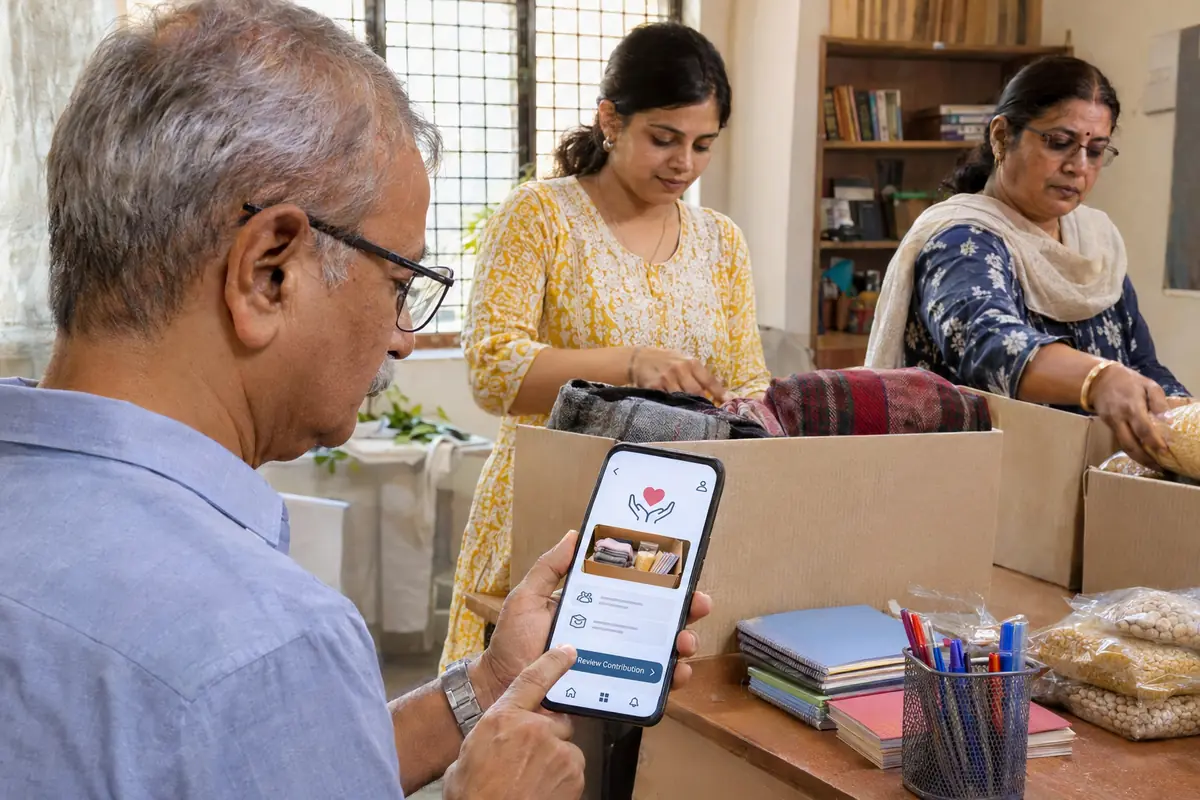
India P2P charity donations are gifts sent from one person to another, or to a cause, through crowdfunding platforms that publish a story, a target amount and a payment link. Donors give without expecting repayment or profit, and the platform handles the page, the payment and some verification. The model has become common for medical bills, school fees and disaster relief, but it brings questions of trust, tax treatment, foreign-contribution rules and fraud that careful donors and organisers should understand before taking part.
Direct giving and the role of platforms
Traditional charity in India runs through temples, mosques, gurdwaras, churches, trusts and well-known non-profit organisations. Peer-to-peer giving adds a second route: a person in need, or someone acting for them, publishes a story and a target, and strangers send small amounts through a website or app. The gift travels from one individual to another, with the platform in the middle handling the page, the payment and, often, some checks.
The model proved useful when families faced sudden hospital bills, when a village needed a well and when a student required fees to complete a course.
India P2P charity donations crowdfunding platforms: what to check first
- Medical treatment, surgery and long hospital stays.
- School and college fees, books and devices for first-generation learners.
- Disaster relief after floods, cyclones or fires.
- Support for farmers, artisans and small traders hit by loss.
- Animal rescue and community projects such as libraries and sports grounds.
- Funeral costs and help for widows or orphans.
Campaigns with a named beneficiary, a clear amount and verifiable documents tend to be the easiest for donors to trust.
How a campaign is built, step by step
- The organiser opens an account, proves identity and links a bank account in the right name.
- A title, story, photographs and supporting documents are uploaded.
- The platform reviews the case and may ask for more proof.
- The link circulates through messaging groups, social media and local networks.
- Donors pay by UPI, card or net banking and receive an acknowledgement.
- Funds are released to the beneficiary or institution, and the organiser posts updates.
Each step is a point where a careful donor can ask for evidence, and a careful organiser can build trust.
Charity, sadaqah and zakat
Many Indian donors want their gift to fit their faith. In Islamic practice, sadaqah is voluntary charity that may be given to anyone in need, while zakat is an obligatory annual payment with defined recipients and rules about who may receive it. A platform that mixes both without explanation can confuse donors, so the page should state clearly which gifts are zakat-eligible and how they are separated.
Similar ideas of dana and seva exist in Hindu, Sikh, Jain and Buddhist traditions, which is why charitable crowdfunding finds support across communities. A donation is a gift: it is not a loan, carries no interest and creates no right to repayment.
Tax receipts and eligible recipients
Indian tax law allows a deduction for gifts to certain approved charitable institutions, usually claimed through a receipt that carries the institution's registration details. A gift to an individual, even a deserving one, does not normally qualify. Donors who need a receipt should therefore ask whether the campaign is run by a registered non-profit and request the receipt in writing.
Amounts received by an individual beneficiary may also have tax consequences for that person, depending on the nature and size of the gift. Beneficiaries should keep records and seek professional advice rather than assume gifts are always exempt.
Foreign donations and extra rules
Money from abroad is subject to a separate law on foreign contributions. Organisations that receive such funds must hold the right registration, and individuals should not accept overseas gifts for a campaign without confirming what is permitted. Cross-border payments also require compliance with foreign exchange rules, which is why many platforms limit foreign card payments for individual campaigns.
Donors abroad who want to help family or a cause in India should use a registered organisation or a platform that explains its legal route clearly.
Fees, tips and where the money goes
Platforms usually earn from payment processing charges, a service fee or an optional tip added at checkout. Optional tips are not compulsory, and donors should read the final amount before paying. Withdrawals to the beneficiary or to a hospital are made by bank transfer, and some platforms pay the institution directly to reduce misuse.
Ask five questions: who receives the money, what share is deducted, how soon funds are released, what happens if the target is missed and what happens to surplus money after a goal is met.
Privacy and dignity of beneficiaries
Public appeals often show a sick child's face or a family's lowest moment. Beneficiaries and guardians should decide how much to disclose, avoid unnecessary photographs of minors and remove personal details once the goal is reached. Donors should not share a story widely without consent, because a viral appeal can bring unwanted attention, scams and pressure on the family.
Medical details, ID numbers and home addresses deserve special care, since they may be used to impersonate the family later.
Spotting fake or misleading appeals
- Stories with no documents, no hospital letter and no contact for verification.
- Photographs copied from other campaigns, found through a reverse image search.
- Urgent messages asking for transfers to a personal wallet or an unknown account.
- Pressure to give immediately and share the link widely.
- Accounts whose holder differs from the person named in the story, without explanation.
Verify by calling the hospital or school, and prefer platforms that publish updates, show donor lists and pay institutions directly.
Giving responsibly and organising a campaign
Donors can give smaller amounts to several verified causes instead of a large amount to one unknown appeal, and keep screenshots and receipts. Organisers should describe the need truthfully, attach documents, name who handles the money, update supporters and thank them with a final accounting. When a goal is exceeded, say plainly whether the extra amount will be passed to another case or returned.
This is general information, not tax or legal advice, and it does not recommend any particular appeal.
Alternatives to online campaigns
Not every need suits a public page. A neighbourhood association, a religious trust, a school management committee or a cooperative may be able to help faster and with less exposure. Government schemes for health, scholarships and relief exist for many categories of need, and a social worker or local office can explain eligibility. Where the need is a temporary cash gap and the person can repay, an interest-free community loan, such as a Qard Hasan arrangement, may be more suitable than a donation, because it preserves dignity and allows the help to be reused for the next person.
Frequently asked questions
Can I claim a tax deduction for a crowdfunding donation to a person?
Usually not. Deductions are generally linked to gifts to approved charitable institutions and need a receipt carrying their registration details. A gift to an individual beneficiary normally lacks that status, so confirm with the organiser and a tax adviser.
How can I tell whether a charity appeal is genuine?
Look for medical or school documents, a named beneficiary, a verifiable account holder, regular updates and a platform that checks cases. Call the hospital or institution where possible, and be cautious about urgent requests to pay a personal number.
Is a donation the same as a loan?
No. A donation is a gift with no repayment, no interest and no profit for the giver. A loan creates an obligation to repay. Platforms that blur the two should be treated with caution, and donors should check the legal form of the campaign.
Further reading
- Milaap : Milaap is a crowdfunding platform for fundraisers in India, showing how individuals and organisations publish medical, education and community campaigns and collect donations online.