
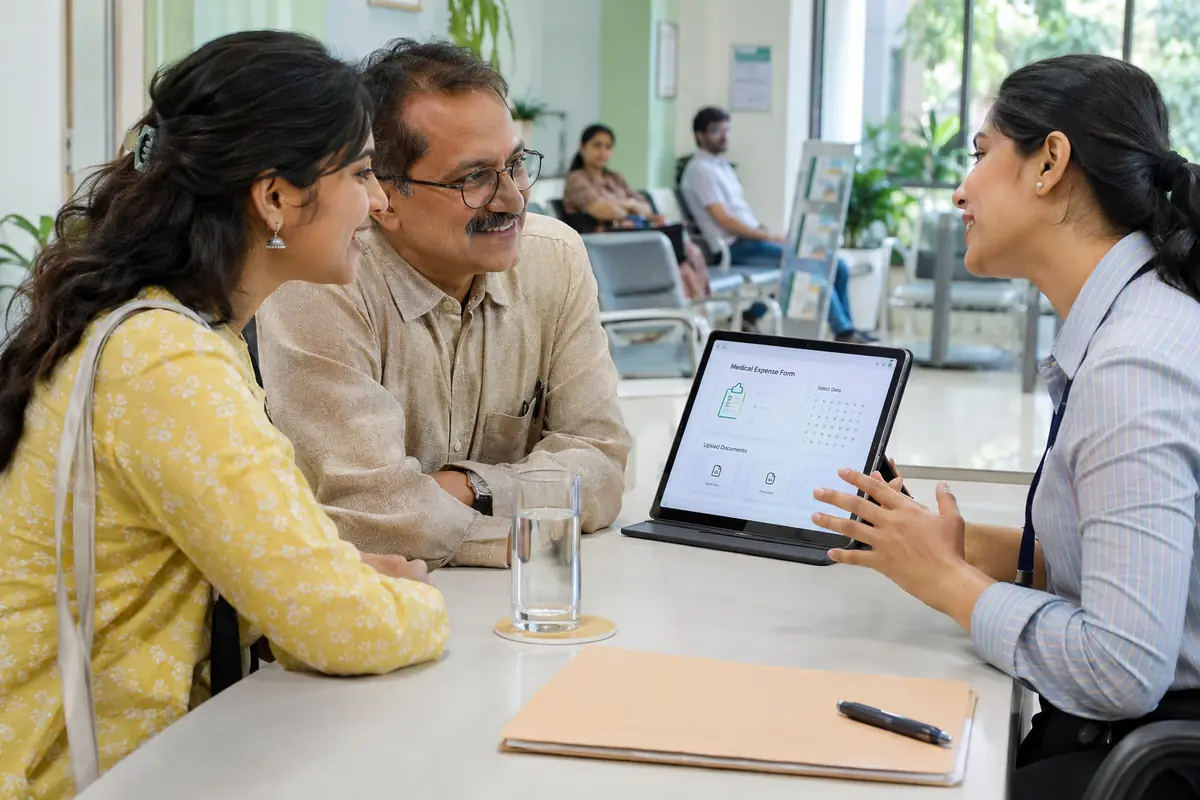
India P2P medical loans are a form of healthcare financing: unsecured credit raised on online platforms to pay for treatment, where individual lenders fund a patient's request instead of a bank. They concern families facing planned surgery, dental work, diagnostics or hospital bills that insurance does not fully cover. A regulated platform registered with the RBI as an NBFC-P2P screens the borrower, lists the need and collects instalments. Money may be released to the patient or, in some cases, towards the provider, and repayment is spread over a tenor of up to 36 months.
Medical costs that often fall outside insurance
Health cover in India is patchy. Many households rely on employer policies with low limits, while a large share have no private cover at all. Even insured patients meet gaps.
- Waiting periods for pre-existing conditions.
- Sub-limits on room rent and specific procedures.
- Dental, cosmetic or elective care excluded from policies.
- Outpatient consultations, medicines and tests.
- Travel and stay costs for treatment in another city.
When a hospital asks for a deposit before admission, families often have only days to arrange money. Peer-funded credit is one route among several that people consider in that window.
Dental treatment, fertility care and physiotherapy programmes are examples of costs that commonly fall into these gaps, since many policies treat them as elective or limit them tightly.
India P2P medical loans healthcare financing: key points before you decide
A patient registers on a platform, completes electronic KYC and describes the amount needed. Supporting papers such as an estimate from the hospital may be requested.
The platform assesses repayment capacity from income and bank data, assigns a risk grade and shows the request to registered lenders. Several lenders commit small sums until the target is reached.
- Verification of identity and income.
- Risk grading of the request.
- Funding by multiple lenders.
- Disbursal to the borrower's account.
- Monthly repayment through an electronic mandate.
Speed depends on how quickly documents are verified and how fast lenders respond, so a genuine emergency may still be better served by other sources first.
A borrower who has the hospital estimate ready, together with recent salary slips or bank statements, usually moves through verification faster than one who must collect papers during the process.
Emergency care versus planned treatment
Planned treatment, such as a scheduled surgery or a dental programme, gives time to compare offers, read agreements and negotiate with the hospital. A borrower can decide on a smaller amount and a comfortable tenor.
Emergencies leave little room for comparison, and that is when people are most exposed to hasty decisions and to fraudulent apps promising instant approval. A rushed borrower may accept high fees without noticing them.
Asking the hospital about instalment plans, charity wards, trust funds or government schemes before taking any private credit often reveals cheaper routes.
Public schemes and other options to compare
Before choosing a private loan, patients should check what public support exists. Government-backed health coverage, state schemes for specific illnesses and hospital welfare funds can reduce the amount that needs to be financed.
Other routes include employer advances, no-cost instalment plans offered by some providers, community collections and charitable trusts. Each has its own eligibility rules and speed.
A P2P loan is best treated as a supplement rather than the first resort, because it adds a repayment burden for months at a time of health stress.
Government health cover in India targets lower-income families through empanelled hospitals, while some states run their own schemes. Eligibility is checked with official records, so enquiring at the hospital's help desk is a practical first step.
RBI rules and the limits that apply
Platforms that arrange peer-funded credit must be NBFC-P2P entities holding an RBI Certificate of Registration. They cannot lend from their own balance sheet, cannot guarantee repayment and cannot promise assured returns.
- Maximum loan maturity: 36 months.
- Aggregate outstanding borrowing for one borrower across platforms: Rs 10 lakh.
- Aggregate lender exposure across platforms: Rs 50 lakh.
- Single lender exposure to the same borrower across platforms: Rs 50,000.
Because of the Rs 10 lakh ceiling, very large procedures may need several sources of funds. The limits do not remove credit risk for lenders.
Platforms also carry duties on disclosure, so key facts such as the rate, fees and repayment dates must be shown clearly before acceptance, and borrowers should keep a copy of everything they accept.
Repayment pressure during recovery
Treatment often brings loss of income. A patient who recovers slowly may struggle to meet fixed instalments, and a missed payment attracts penalties and a poorer credit record.
Borrowers should size the loan conservatively, include time off work in the calculation and keep a small reserve for follow-up visits. Asking early for a revised schedule is better than silence, since genuine platforms have grievance processes.
Never take a larger amount than the hospital estimate requires, because extra cash increases the burden without improving care.
Interest-free community support
Many families look first to community help. A genuine Qard Hasan loan, also known as Qarz-e-Hasana, returns only the principal, with no predetermined return to the lender.
Some cooperatives charge a fixed service fee for administration. Murabaha and Ijarah contain a profit or rental element and suit asset purchases more than medical bills.
Most interest-free systems in India run through community, charitable or cooperative arrangements, not RBI-registered NBFC-P2P apps, so approval depends on local rules and available funds.
Checks that protect patients
Health emergencies attract scammers. Before applying anywhere, confirm the legal identity of the company and its RBI registration, and read every charge in the agreement.
- Refuse any request to pay a fee before the loan is released.
- Do not share one-time passwords or card details.
- Deny access to contacts and photo galleries.
- Keep written proof of the sanctioned amount and schedule.
The information given is general and is not personal advice or a loan offer.
Choosing the amount and the tenor
A shorter tenor lowers total interest but raises the monthly instalment, which can strain a household during treatment. A longer tenor eases the monthly burden but increases the overall cost.
Many patients find it helpful to list expected costs in three groups: the main procedure, medicines and follow-up care, and income lost during recovery. Borrowing for the first two only, and covering the third from savings or family support, keeps the loan manageable.
Lenders on a platform see the stated purpose and the grade, not the patient's medical record, and the borrower should avoid uploading sensitive diagnoses beyond what the process requires.
Frequently asked questions
Can a P2P loan be used to pay a hospital bill?
Yes, many platforms accept medical needs as a purpose, and funds may be paid to the borrower or towards the provider. Approval still depends on income, repayment capacity and the risk grade, and the borrower must repay in instalments within 36 months.
Is there a limit on medical borrowing through P2P platforms?
Yes. Under RBI rules, one borrower's aggregate outstanding borrowing across platforms cannot exceed Rs 10 lakh, and a single lender can put at most Rs 50,000 into the same borrower. These ceilings do not remove credit risk for either side.
What should patients check before accepting a medical loan?
Verify the platform's legal identity and RBI registration, read the full cost schedule including fees and penalties, and confirm no advance payment is requested. Also compare insurance, public schemes and hospital instalment plans, because cheaper support may already exist.
Further reading
- Ketto : Ketto is an Indian crowdfunding platform where families can start a medical fundraiser, a donation route to consider before taking a private loan for treatment.